It starts with a spreadsheet victory. You found a pen supplier in Vietnam who is $0.20 cheaper. You found a notebook factory in China who is $0.30 cheaper. And you found a local box manufacturer who is competitive.
On paper, you just saved the company $5,000 on the annual corporate gift set. In reality, you are building a "Frankenstein" monster.
The Coordination Nightmare
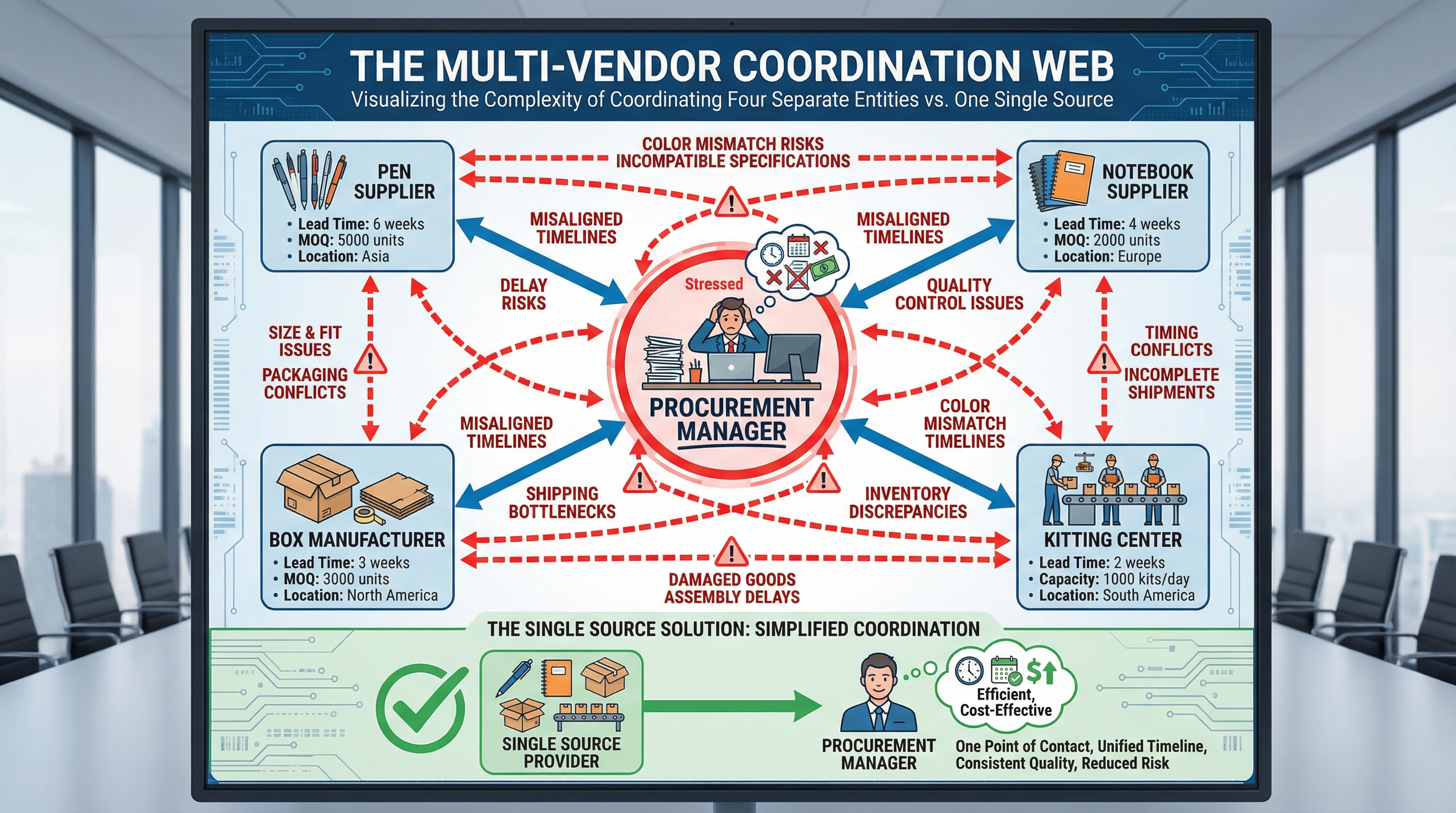
As a Senior Procurement Consultant, I've seen this scenario play out dozens of times. When you split a gift set across 3-4 vendors, you become the System Integrator.
Suddenly, you are managing:
- 3 Separate Lead Times: If the pens are late, the boxes sit empty in a warehouse (incurring storage fees).
- 3 Separate Freight Bills: Often negating the unit cost savings.
- The "Finger Pointing" Game: When the notebook doesn't fit in the box foam, the box maker blames the notebook maker's dimensions, and the notebook maker blames the box maker's die-cut.
The "Navy Blue" Illusion
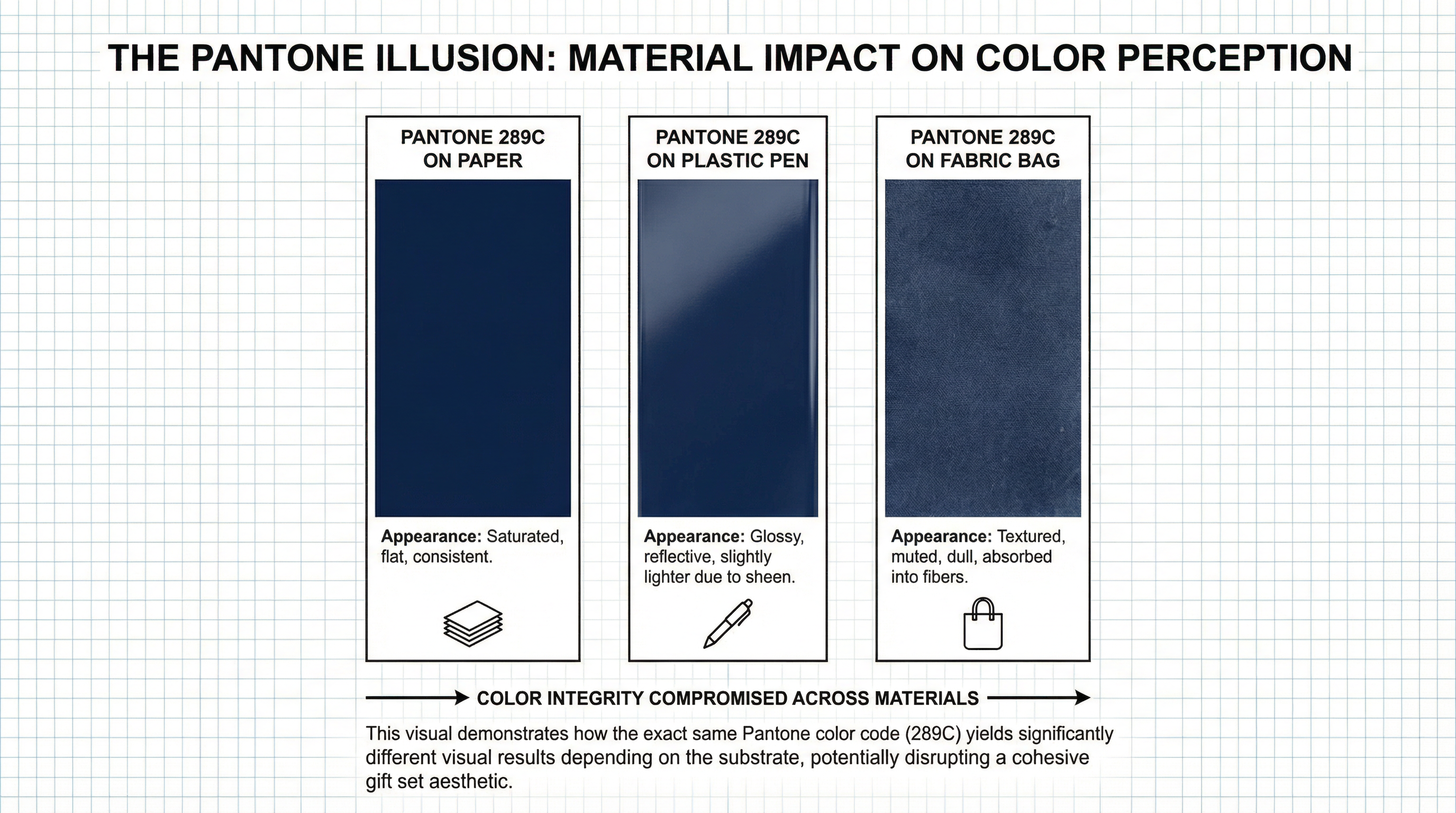
In practice, this is often where sourcing decisions start to be misjudged. You send "Pantone 289C" (Navy Blue) to all three vendors.
But Pantone 289C on paper looks different than Pantone 289C on plastic, which looks different than Pantone 289C on fabric.
When the items arrive and are placed side-by-side in the box, the visual dissonance is immediate. The pen looks purple-ish, the notebook looks black-ish, and the box is true navy. The "premium" feel is instantly destroyed because the set lacks visual cohesion.
The Hidden Cost: Kitting Labor
Who puts the items in the box?
If you buy from separate vendors, you (or a 3rd party logistics provider) have to do the kitting. This is manual, time-consuming labor. Unpacking 500 cartons of pens, unwrapping them, placing them in the box, re-sealing the box...
We have seen projects where the "kitting fee" charged by the local warehouse was $2.50 per set—completely wiping out the $0.50 savings from sourcing the pen separately.
The Single-Source Advantage
- Unified Color Control: A single vendor can adjust the ink formulas across materials to ensure they visually match, not just numerically match.
- Fit Guarantee: The vendor is responsible for ensuring the pen fits the foam cut-out. If it doesn't, it's their problem to fix before shipping.
- Pre-Kitted Arrival: The sets arrive ready to hand out. No warehouse labor required.